
The Smart Guide to Rhinoplasty
What you must know before getting a nose job.
Amazon Bestseller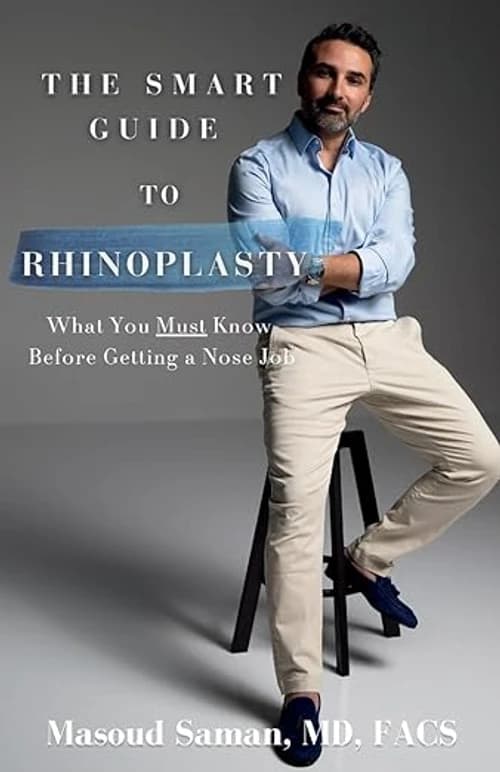
“An impressively knowledgeable and supportive look at the intricacies of rhinoplasty.”
Written before the first question is asked.
I wrote The Smart Guide to Rhinoplasty because I saw too many people making major decisions without the right information. Over the years, I met patients who were confused by marketing language, influenced by trends on social media, or unsure of what was truly possible. Some had already been through surgery and were now dealing with results they never wanted.
This book is meant to be a clear and honest guide. I wanted to offer something that could help people slow down, ask the right questions, and understand what rhinoplasty really involves. It walks through the entire journey in plain language, from motivations and expectations to recovery and outcomes.
— Dr. Masoud Saman
Every chapter, opened to its first page.
Search the book, open a chapter, read the opening passage. The rest lives between the covers.
01IntroductionWhy this book exists — and why the journey matters more than the procedure.
Rhinoplasty is more than just a surgical procedure, it’s a journey. For many, it’s a deeply personal decision, tied to self-confidence, identity, and even function. Whether you’re considering rhinoplasty to enhance your appearance, improve breathing, or correct a previous surgery, making the right choice is crucial. This book is here to help.
After years of intensive training—medical school, a five-year surgical residency in ear, nose, and throat at a top program, and specialized fellowships in head and neck oncology, microvascular reconstruction, skull base surgery, and facial plastic and reconstructive surgery—I earned double board certification. You’d think that after all that, I’d be fully prepared to deliver impeccable results. But in reality, my true education had only just begun. I had just arrived at the base of the mountain.
The chapter continues — the pursuit that turned decent results into a life’s craft. Continue in the book →
02My Journey as a Rhinoplasty SurgeonFrom a middle-class childhood and a mother’s art to a life devoted to the face.
Ever since I was a child, I wanted to be a physician.
No, I’m kidding. That’s not true at all.
No one in my family was a doctor, and I knew little about physicians—except that they intimidated me. As a child, I half-believed they could read my mind—or could they? Later, I saw many as distant, even arrogant. Besides, my family wasn’t wealthy. Becoming a doctor felt like a privilege reserved for the well-off—certainly not for someone like me.
The chapter continues — a mother’s artistry, an unlikely path, and how it shaped a surgical eye. Continue in the book →
03The Importance of the Nose and Its ShapeIdentity, heritage, and why one feature carries so much emotional weight.
The human nose is much more than a simple breathing apparatus, it’s an anchor of identity, a marker of heritage, and a powerful symbol in language, culture, and history. Its shape and structure have fascinated people for millennia, inspiring everything from mythology to modern beauty ideals. Across civilizations, the nose has been admired, criticized, adorned, exaggerated in art, and even used as a basis for judgment.
Why does this one feature carry so much weight? Why is it so emotionally charged for so many? The answer lies in a mix of evolution, psychology, culture, and history.
The chapter continues — self-perception, evolution, and why we see ourselves through the nose. Continue in the book →
04A Brief History of RhinoplastyFrom Sushruta in ancient India to the modern operating suite.
Rhinoplasty, one of the oldest surgical procedures known to humankind, has a fascinating and intricate history that spans thousands of years. It is a procedure that, at its core, has always sought to restore form and function—whether to repair injury, correct congenital defects, or refine aesthetic harmony.
The earliest documented evidence of nasal reconstruction can be traced back to ancient India around 600 BCE, where the pioneering surgeon Sushruta described techniques for nasal reconstruction in the Sushruta Samhita—a technique that, although modified and refined, remains foundational in reconstructive surgery today.
The chapter continues — Persia, the Renaissance, and the birth of the modern nose job. Continue in the book →
05Understanding Nasal Anatomy and Ethnic Considerations in RhinoplastyWhat “smaller” really means — and why one-size-fits-all erases identity.
A patient once told me, “I just want a smaller nose.” But what does smaller truly mean? For one person, it might involve narrowing the tip; for another, reducing the dorsum. Without understanding the fundamental anatomy of the nose, even patients themselves may struggle to articulate exactly what they want or what they genuinely need.
Historically, surgical training often focused predominantly on one nasal type, causing some surgeons to apply uniform techniques and aesthetic ideals to every patient. This one-size-fits-all approach risks erasing unique ethnic characteristics and frequently leads to unnatural, homogenized outcomes.
The chapter continues — the landmarks of the nose and refinement that respects heritage. Continue in the book →
06The Psychology of Rhinoplasty: Understanding the Emotional Factors Behind SurgeryThe desire often begins at eleven or twelve — and it is rarely about vanity.
Rhinoplasty is seldom about aesthetics alone. The nose represents far more than just a physical attribute—it is intricately woven into our identity, culture, personal history, and sometimes even emotional trauma. Positioned centrally on the face, it is the anchor that defines balance and harmony. Often, when patients seek nasal surgery, they aren’t simply pursuing cosmetic enhancement; they desire alignment between their inner sense of self and their outward appearance.
Many of my patients share a common sentiment: “I’ve wanted this since I was eleven or twelve years old.”
The chapter continues — when surgery helps, and when the nose becomes a scapegoat. Continue in the book →
07Why People Get Rhinoplasty: Motivations and Adaptations“It just doesn’t fit my face” — the real reasons patients walk in.
Have you ever looked in the mirror and felt like your nose just doesn’t belong? Not bad—just… off? That’s something I hear often from my patients. They don’t necessarily want a smaller nose or a completely different one. They want a nose that looks like it was meant for them.
Many patients tell me they avoid big smiles in photos because they feel their nose takes over their entire face. As they smile, the tip drops, the nostrils flare, and suddenly, all they notice is their widening nose. Some even train themselves to smile minimally, afraid that a full expression will make their nose look exaggerated.
The chapter continues — when puberty changes everything, and adaptations people never admit. Continue in the book →
08Unrealistic Expectations and Body Dysmorphic Disorder — When Surgery May Not Be the Right ChoiceThe honest chapter: when the answer is no.
A young woman once sat across from me in my office, clutching a photo of herself—except it wasn’t really her. The image had been edited beyond recognition. “I want my nose to look like this,” she said, her voice filled with both hope and desperation. But what she was chasing wasn’t a nose—it was an illusion. And illusions can’t be surgically created.
One of the greatest misconceptions about rhinoplasty is the belief that a perfect nose exists. It doesn’t. Perfection is not the goal, harmony is. A nose should look like it belongs on your face, not someone else’s.
The chapter continues — recognizing BDD, and why a good surgeon sometimes declines to operate. Continue in the book →
09The 80/20 Rule of Aesthetic SurgeryNo surgery gets you 100% of the way. The remaining 20% is life.
Sofia stood in front of the mirror, her fingers tracing the bridge of her nose. Then she whispered the words I had heard so many times before. “I hate it.” The nose reflected back at her was exactly what we had planned—balanced, refined, elegant. But none of that mattered. She didn’t see what was there. She saw what wasn’t.
“No surgery gets a patient 100% of the way to their ideal result. At best, we get them to 80%. The remaining 20%? That’s life.” That 80% can be life-changing. But there will always be a fraction left untouched.
The chapter continues — the crayon-marks story, and how to hold both gratitude and precision. Continue in the book →
10Social Media: The Impact of Filters, Influencers, and Online Beauty StandardsA double-edged sword — how the feed reshaped what patients ask for.
A nineteen-year-old patient sat in front of me, clutching her phone. “This is what I want,” she said, turning the screen toward me. On it was an AI-generated version of her face, her nose altered into something that didn’t exist in nature. I sighed. I had seen this before—many times.
Social media has completely reshaped the way people perceive beauty. Instagram, TikTok, and Snapchat have given patients unprecedented access to before-and-after results, surgical techniques, and firsthand accounts of rhinoplasty. With this exposure comes a cost—unrealistic expectations, distorted beauty ideals, and the pressure to conform to a curated version of reality.
The chapter continues — selfie dysmorphia, the illusion of effortless recovery, and when medicine becomes a performance. Continue in the book →
11Breathing Matters: The Functional Side of RhinoplastyA nose that looks perfect but doesn’t breathe properly is not a success.
When you look at a nose, what do you notice first? Its shape? Symmetry? How well it fits a person’s face? Aesthetics are usually what draw attention, but the most important function of the nose isn’t how it looks—it’s how it breathes.
Nasal breathing is something most people take for granted—until they can’t. Some patients even break down in tears after surgery, not because of how their nose looks, but because they’ve never been able to breathe this well in their entire lives.
The chapter continues — the airway, sleep, and why form and function are inseparable. Continue in the book →
12What Is the Best Age for Rhinoplasty?There is no single perfect age — only the right time for each individual.
One of the most common questions I hear from patients—and often from their parents—is, “What is the right age for a nose job?” The short answer is that it depends.
After performing thousands of rhinoplasties, I can confidently say there is no single perfect age, only the right time for each individual. Some patients seek refinement in their teenage years, others wait until their late twenties or thirties, and some finally decide in their fifties or sixties. Your nose is with you for life, and the best time is when you are truly ready—physically, emotionally, and mentally.
The chapter continues — teenage rhinoplasty, adult timing, and the questions to ask at every age. Continue in the book →
13Why Revision Rhinoplasty Is More ComplexNot a do-over — a meticulous reconstruction.
When patients come in for a consultation about revision rhinoplasty, they are often surprised—sometimes even shocked—by what they hear. “Wait, why does a revision take longer?” “Why does it cost more?” “Why is the healing harder than the first time?”
These are fair questions. Most people assume that a revision is just another attempt at their original surgery, a quick fix to correct what didn’t turn out right the first time. But nothing could be further from the truth. Revision rhinoplasty is not simply a do-over, it’s a meticulous reconstruction that requires careful planning, patience, and, above all, the right mindset.
The chapter continues — Sarah’s story, and what a second chance actually requires. Continue in the book →
14The Truth About Nonsurgical Rhinoplasty: Illusion, Risks, and the Long-Term ImpactA useful tool, not magic — and in the wrong hands, harmful.
Over the past decade, more and more patients have turned to nonsurgical rhinoplasty as a quick fix for nasal refinement. I get it—the idea of enhancing your nose without surgery is appealing. The procedure is marketed as fast, painless, and reversible, a way to “try out” a new nose without the commitment of surgery.
But like everything in aesthetics, nonsurgical rhinoplasty has its place and its limitations. It’s a useful tool, but it’s not magic. And in the wrong hands, it can cause more harm than good. Unlike surgical rhinoplasty, which physically reshapes the nose, it works by masking irregularities rather than modifying underlying structure. It’s an illusion.
The chapter continues — how fillers actually work, real risks, and the long-term picture. Continue in the book →
15The Nose in Facial Harmony: The Art of BalanceA refined nose out of sync with the face is not beauty.
A well-proportioned nose is never just about the nose itself. It exists within the context of the entire face, and its beauty lies in how seamlessly it blends with the surrounding features. Patients often come to me with a singular focus—a dorsal hump, a drooping tip, a width that feels too broad. But the truth is, achieving a natural and elegant result requires stepping back and considering the face as a whole.
A small or recessed chin can create the illusion of a nose that looks too large. In many cases, a subtle chin enhancement could bring the entire face into better proportion.
The chapter continues — asymmetry, chin projection, and the geometry of a face at rest. Continue in the book →
16How to Prepare for Your Rhinoplasty ConsultationWalk in informed. Walk out certain.
This chapter is designed to equip you with the knowledge and confidence to navigate your rhinoplasty consultation with ease. The goal is not just to find a qualified surgeon but to find the right surgeon for you—one who understands your vision, communicates openly, and has the experience to achieve a result that complements your natural features.
It’s wise to meet with at least two, ideally three, surgeons before making a final decision. Each consultation offers a different perspective, allowing you to assess surgical styles, bedside manner, and overall approach. The right choice is about more than credentials, it’s about trust and alignment in aesthetic goals.
The chapter continues — the exact research to do, and the questions worth asking. Continue in the book →
17Computer Simulations and 3D ModelsSee your new nose before surgery — and know exactly how much to trust it.
What if you could see your new nose before surgery? With today’s digital simulations and 3D modeling, this is possible. But how accurate are these previews? More importantly—should you trust them?
As with any tool, there are limitations. A simulation is not a promise, and it certainly isn’t a crystal ball. The human body is not a static, digital object—it is dynamic, living tissue that heals and settles in ways that no software can fully predict. I always encourage patients to approach simulations as a guide, not as an absolute guarantee.
The chapter continues — the power and limits of imaging, and how AI sharpens the plan. Continue in the book →
18Open vs. Closed Rhinoplasty — The Differences, Pros, and ConsThe most debated question in rhinoplasty, answered without dogma.
One of the most debated topics in rhinoplasty is whether open or closed rhinoplasty is the better approach. Patients often ask, “Which one is better?” or assume that closed rhinoplasty is superior simply because it leaves no external scar. Even among surgeons, opinions vary widely, often shaped by their training rather than objective differences between the techniques.
The truth is, both methods are far more similar than most people think. I choose my approach based on the patient’s unique anatomy, surgical goals, and long-term outcome, not a rigid preference for one method over the other.
The chapter continues — what each approach truly offers, case by case. Continue in the book →
19Preservation Rhinoplasty vs. Structural Rhinoplasty: An OverviewTwo philosophies, one goal — and why mastery of both matters.
Rhinoplasty is not a one-size-fits-all procedure. Every nose is unique, and over time, surgical techniques have evolved to offer different approaches depending on a patient’s anatomy, goals, and functional needs.
Rather than removing a hump, for example, preservation rhinoplasty lowers the bridge from beneath, maintaining the continuity of the nasal dorsum while achieving a balanced and harmonious appearance. Neither approach is inherently superior; the most skilled rhinoplasty surgeons are those who master both techniques and adapt their approach to each individual rather than following a single philosophy.
The chapter continues — two parallel traditions, and how the right one is chosen for you. Continue in the book →
20Modern Advances in Rhinoplasty: Technology, Precision, and the FutureUltrasonic sculpting, AI analysis, regenerative medicine — the state of the art.
Nasal surgery has always been a delicate balance between art and science. The introduction of ultrasonic bone sculpting, AI-driven facial analysis, bioengineered cartilage, and regenerative treatments like exosomes and platelet-rich fibrin is revolutionizing the field.
For decades, nasal bone reshaping was done using manual chisels, rasps, and osteotomes—effective tools but ones that relied on force rather than finesse. Ultrasonic rhinoplasty has changed that. Using high-frequency sound waves, ultrasonic instruments allow surgeons to sculpt nasal bones with extraordinary precision—cutting bone without affecting soft tissue, blood vessels, or cartilage.
The chapter continues — the technologies reshaping outcomes, and which ones actually matter. Continue in the book →
21True Craftsmanship and the Pursuit of ExcellenceKaizen, Jiro Ono, and why artistry should be non-negotiable.
In a world where convenience and speed often take precedence over mastery and excellence, true craftsmanship is becoming a rarity. But there are still those who dedicate their lives to their craft—those who do not seek shortcuts, who do not compromise for the sake of volume, and who hold themselves to a higher standard.
These are the artisans, the masters of their field, and when it comes to something as deeply personal and transformative as rhinoplasty, artistry and craftsmanship should be non-negotiable. Mastery is not a title one earns and then rests upon. It is a lifelong pursuit.
The chapter continues — the sushi master’s lesson, and what Kaizen looks like in the operating room. Continue in the book →
22Style MattersIf you take a big potato and make it smaller, it’s still a potato.
Rhinoplasty isn’t just about making a nose smaller, it’s about making it more beautiful. More refined, more harmonious, and more suited to the individual face it belongs to. Yet, I constantly see patients focusing only on size reduction, assuming that a smaller nose is automatically an improvement.
I often joke with my patients: If you take a big potato and make it smaller, it’s still a potato. A well-executed rhinoplasty is about sculpting. A nose should never look “done” or like it belongs to someone else. It should look like it was always meant to be there.
The chapter continues — how a surgical style is forged, and why yours should match your surgeon’s. Continue in the book →
23When Choosing a Rhinoplasty SurgeonSubstance vs. hype — and why your instincts are data.
Choosing a rhinoplasty surgeon is one of the most significant decisions you will ever make. Done well, rhinoplasty enhances facial harmony, respects a patient’s natural features, and maintains or even improves breathing function. Done poorly, it can lead to unnatural results, functional issues, and the need for complex revision surgery.
Yet, with the overwhelming amount of information available, many patients struggle to separate substance from hype. Surgeons can buy followers, pay for awards, and curate an online image that doesn’t always reflect their true skill or patient satisfaction.
The chapter continues — what actually predicts excellence, and when to trust your gut. Continue in the book →
24How to Assess Before-and-After Photos CriticallyLighting, lenses, angles — reading results like a professional.
Before-and-after photos are one of the most useful tools for evaluating a rhinoplasty surgeon’s work. They provide a tangible way to assess a surgeon’s aesthetic style, their approach to nasal refinement, and the quality of their results. However, while these images can be incredibly informative, they should also be viewed with a discerning eye.
Lighting can significantly impact how a nose looks. Lens distortion is another factor—some “before” photos are taken with a wide-angle lens that makes the nose look larger, while “after” photos may be captured with a more neutral lens, making the difference seem more pronounced.
The chapter continues — a practical checklist for reading any surgeon’s gallery honestly. Continue in the book →
25The Setting Matters as Much as the SurgeonWhere the surgery happens — and who is in the room — shapes the outcome.
When people think about rhinoplasty, they focus almost entirely on choosing the right surgeon—reviewing credentials, before-and-after photos, and patient testimonials. But one factor that’s just as important, and often overlooked, is where the surgery takes place and who is in the room. These elements don’t just shape the experience; they influence the outcome in ways most patients never realize.
In a hospital setting, you’re one of many patients. The staff working with you—the nurses, anesthesiologists, and surgical assistants—are different every time.
The chapter continues — why a dedicated, accredited suite and a hand-picked team change everything. Continue in the book →
26The Financial Aspect of Rhinoplasty: Price, Cost, ValueThe question isn’t “how much” — it’s “what does that price actually include?”
One of the first questions patients ask when considering rhinoplasty is, “How much does it cost?” It’s a fair question. Rhinoplasty is a significant financial investment—often one of the most substantial personal expenses someone considers. But there’s an even more important question that many forget to ask: “What does that price actually include?”
Rhinoplasty costs vary widely. Some quotes seem steep, while others look like a bargain. But price alone doesn’t tell the whole story.
The chapter continues — Emily’s story, and the true cost of a bargain. Continue in the book →
27Navigating the Realities of Medical TourismGreat surgeons exist everywhere. So do devastating outcomes. Here’s the full picture.
The appeal is undeniable. A “luxury” surgical experience abroad, often at a fraction of the cost, complete with five-star accommodations and the promise of a quick, seamless transformation. It’s easy to see why more and more patients are choosing to travel for rhinoplasty.
And let me be clear: exceptional rhinoplasty surgeons can be found all over the world. At the same time, I’ve seen firsthand the devastating consequences of choosing a surgeon based solely on price or location. What matters is not where a surgeon is based, but who they are.
The chapter continues — what happens if something goes wrong, and the questions that protect you. Continue in the book →
28Common Myths About Rhinoplasty: Separating Fact from FictionThe misinformation that makes people hesitate — corrected.
Despite all the advancements in the field, myths about rhinoplasty persist. Misinformation spreads easily, whether through social media, outdated medical advice, or unrealistic portrayals in entertainment. Some misconceptions make people hesitant about the procedure, while others create false expectations that lead to disappointment.
A common misconception is that rhinoplasty is purely a cosmetic procedure. In reality it is frequently performed to correct functional issues, such as breathing difficulties caused by a deviated septum, nasal valve collapse, or previous trauma. No surgical result can be considered successful if it compromises nasal function.
The chapter continues — the most persistent myths, dismantled one by one. Continue in the book →
29How to Talk to Family and Friends About Your Decision“But I love your nose the way it is” — navigating the people who love you.
Deciding to undergo rhinoplasty is a deeply personal choice, often made after years of consideration. But while you may feel ready, sharing this decision with family and friends can be a different kind of challenge. Even those who love and support you might have opinions—some encouraging, others skeptical, and a few outright dismissive.
A mother might say, “But I love your nose just the way it is,” not realizing that her attachment to your appearance doesn’t necessarily reflect how you feel about it. These concerns are natural and don’t mean they disapprove—they simply need reassurance.
The chapter continues — scripts and mindsets for every kind of reaction. Continue in the book →
30Trusting the Process Is KeyYou chose a master architect — now let them build.
One of the most important things I’ve observed repeatedly in my practice is the relationship between patient mindset, trust, and the ultimate success of rhinoplasty. Those who approach their journey with patience, positivity, and trust in both their surgeon and the healing process tend to experience smoother recoveries and better outcomes.
Just as you wouldn’t hire a world-class architect to design your home and then change every structural detail they recommend, you should avoid dictating every surgical detail. Once you’ve done your due diligence and made your choice, allow them to do their best work.
The chapter continues — where collaboration ends and craftsmanship begins. Continue in the book →
31Final ThoughtsThe most beautiful noses don’t demand attention. They complement.
Choosing to undergo rhinoplasty is not just about reshaping your nose—it’s about refining your confidence, enhancing your harmony, and making a choice that feels right for you. This book is not about persuading you to have surgery, or not have surgery. I wrote it to empower you with the knowledge to make an informed decision—one rooted in truth, not trends; in self-reflection, not pressure.
The most beautiful noses don’t demand attention. They don’t overpower. They complement. They refine. They enhance without erasing identity.
The book closes — and, when you’re ready, the conversation begins. Continue in the book →
No chapter matches that — but the book probably covers it. Look inside on Amazon.
About the book.
What does The Smart Guide to Rhinoplasty cover?
The book walks through the entire rhinoplasty journey: nasal aesthetics and anatomy, the major surgical techniques, how to choose the right surgeon and recognize red flags, ethnicity and facial harmony, the psychology and motivations behind the decision, realistic expectations, recovery, and revision surgery.
Who is the book for?
Anyone considering a nose job — from those just beginning their research to patients preparing for surgery or weighing a revision. It is written in plain language for patients, though surgeons and trainees read it as well.
Where can I buy it?
The book is available on Amazon in paperback and ebook (ISBN 9798218632243), and through other major booksellers including Barnes & Noble and Waterstones.
Is the full book available on this website?
No. This page shares only the opening passage of each of the 31 chapters — a first page, not the chapter itself. The complete text is available wherever the book is sold.
Does reading the book replace a consultation?
No. The book prepares you to ask the right questions, but every nose and every face is different. A consultation with Dr. Saman or Dr. Ahmedli is where a plan specific to your anatomy begins.
Read it before you decide anything.
The best rhinoplasty decisions are made slowly, with the right information. Start with the book. When you’re ready, we’re here.